DANIELA FRONGIA
Bianco e Nero
Bianco e Nero is the title of Daniela Frongia’s solo presentation held at the headquarters of CONTEMPORALIS in collaboration with the Italian Cultural Institute in Paris and the Italian association In-Edita. Daniela Frongia is also the first winner of the Prix Contemporalis.
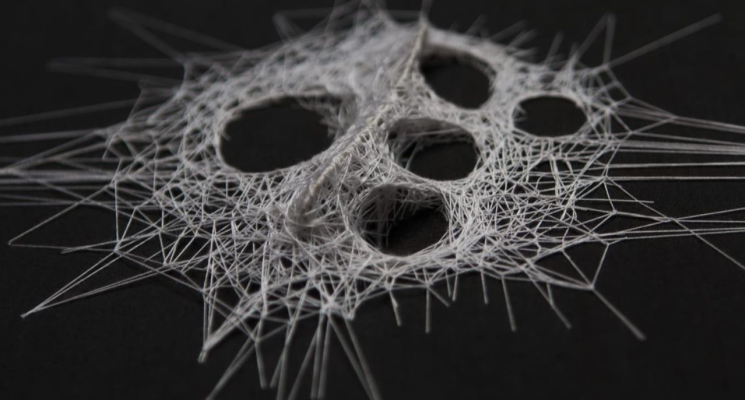
The works on display are the result of a research that Daniela Frongia has been pursuing for many years, focusing exclusively on black and white. The artist strips the works of colour, investigating their surface as a rhythm that marks the passage of time. Fullness and emptiness, rigidity and softness are the key elements that outline new visions and experiences. Thread crosses the canvases through slow and repetitive gestures, extending beyond them to explore the surrounding space. Light, an intangible element, invades the empty space and projects itself elsewhere with a sense of continuity. Textile and organic architectures move within the exhibition environment, opening up further perspectives.
In Daniela Frongia’s work, traditional weaving dissolves its warp and weft to produce three-dimensional geometries that are often unstable and ephemeral. Her research expresses a profound sense of suffering for the rapid evolution of contemporary society, where image, technology and progress prevail at the expense of feelings and human relationships. Matter thus becomes an introspective tool, while the artwork becomes the necessary element that allows us to pause, observe and question.
Daniela Frongia, born in San Gavino Monreale (Sardinia) in 1981, began her artistic training at the State Art Institute “Carlo Contini” in Oristano and later completed her studies at the Academy of Fine Arts in Florence, graduating in Set Design and Contemporary Art History. She has taken part in several artist residencies and workshops in Italy and abroad and was selected for the fifth and sixth editions of Networking, a project dedicated to the promotion of contemporary art in Tuscany, during which she worked alongside international figures such as John Duncan and Cesare Pietroiusti.
Her research encompasses a wide range of expressive media, including installations, performances, video and photography, which evolve within different experimental fields such as Fiber Art, Social Art, Art Psychology and Street Art. She currently lives and works in Sardinia, where she produces textile fibres through the cultivation of flax and cotton, the use of Sardinian sheared wool and even her own hair, from which she creates threads for small-scale works. The artist has presented numerous solo and group exhibitions and has received national and international awards. Her works are held in public and private collections.